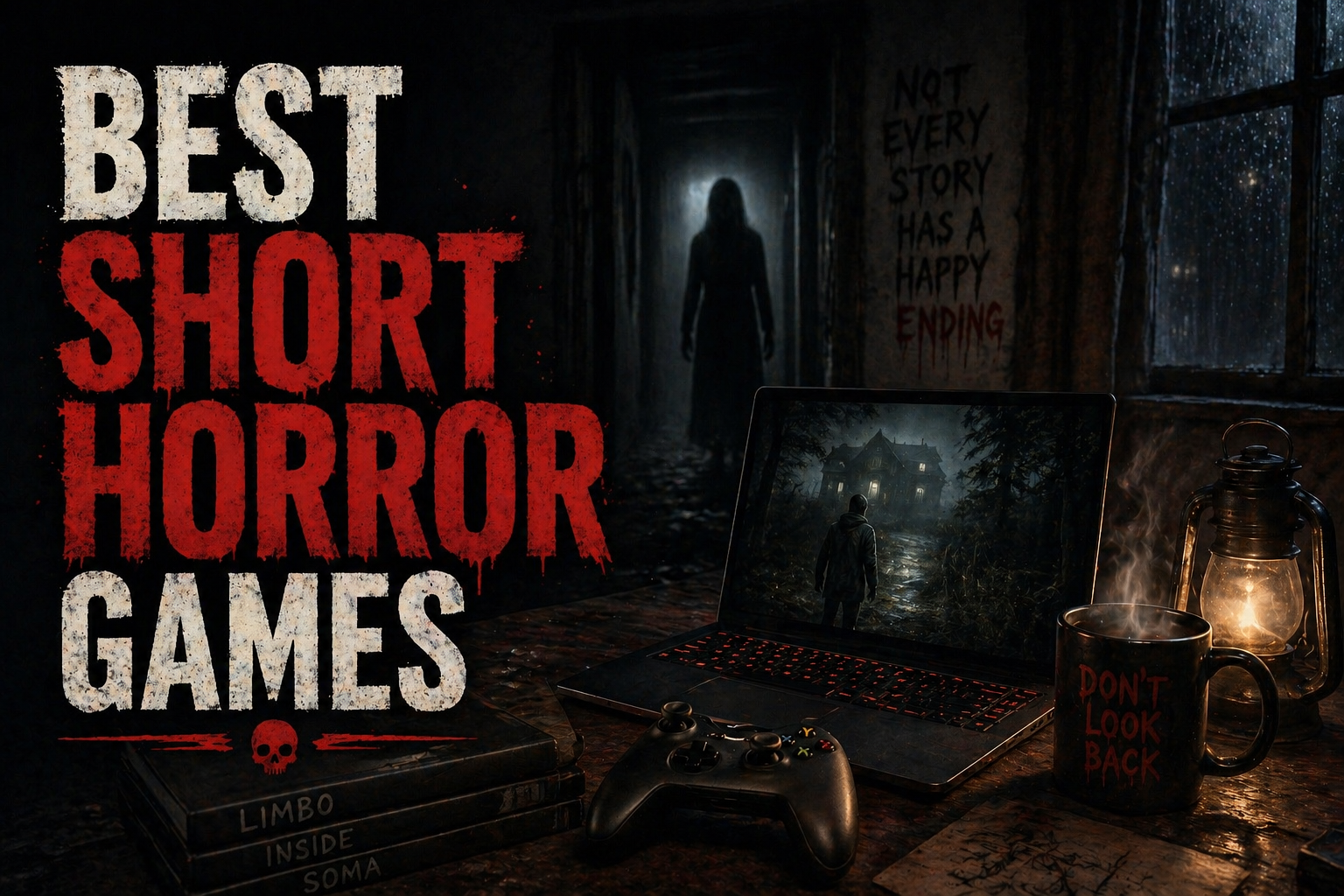

There’s something deeply satisfying about a horror game that gets under your skin without demanding forty hours of your life. You know the feeling—it’s Sunday evening, you’ve got maybe two or three hours before the week kicks off again, and you fancy something that’ll give you a proper scare without the commitment of a sprawling open-world adventure. Short horror games are perfect for exactly that, and if you’re looking for a wider mix beyond just horror, our guide to Best Short Single-Player Games You Can Finish is a solid place to start.
The best ones don’t mess about. They understand that fear works better when it’s concentrated, when you don’t have time to get comfortable or develop coping strategies. They’re designed to disturb you efficiently, then let you get on with your life—though you might find yourself thinking about them for days afterwards. Here are some of the best short horror experiences that respect your time whilst still delivering genuine scares.
Iron Lung
Playtime: 1-2 hours
This one’s properly unsettling. You’re piloting a ramshackle submarine through an ocean of blood on an alien moon, navigating entirely through static photographs and proximity sensors. Iron Lung proves that imagination is far more frightening than any monster model—you never actually see what’s out there in the murky depths, but you’ll definitely hear it.
The claustrophobic interface and lo-fi aesthetic create a sense of dread that builds with every creaking movement of your vessel. It’s incredibly focused, with no padding whatsoever, and you can complete it in a single sitting. Available on Steam for around £5 ($6), it’s also one of those games that’ll stick with you long after you’ve surfaced.
Metacritic Score: 82
The Mortuary Assistant
Playtime: 3-4 hours (multiple endings)
If you’ve ever wondered what it would be like to work the night shift at a mortuary whilst also dealing with demonic possession, well, here’s your answer. The Mortuary Assistant combines routine embalming procedures with genuinely effective jump scares and a creeping sense that something’s very wrong.
What makes this work so well for busy players is its structure—each shift is relatively short, but there are multiple endings to discover if you want to dig deeper. The gameplay loop of preparing bodies whilst watching for signs of possession creates brilliant tension, and the game doesn’t overstay its welcome. It typically costs around £18 ($25) and offers excellent value for the scares delivered.
Metacritic Score: 79
MADiSON
Playtime: 6-8 hours
Admittedly on the longer end of “short,” but MADiSON is paced well enough that you can tackle it across a few evenings. This first-person psychological horror centers around an instant camera that captures things you really don’t want to see—and bridges the gap between the living world and something far more sinister.
The puzzle-solving keeps you engaged without becoming frustrating, and the scares are well-distributed throughout. It feels like a spiritual successor to P.T. without trying too hard to copy it. Available for around £30 ($35), it’s one of those horror games that understands atmosphere is everything. The camera mechanic adds a unique twist that keeps things fresh throughout.
Metacritic Score: 76
Chilla’s Art Collection
Playtime: 1-3 hours per game
If you haven’t discovered Chilla’s Art yet, you’re in for a treat. This Japanese development team specializes in short, bite-sized horror experiences often set in mundane locations—convenience stores, train stations, video rental shops. Games like The Convenience Store and The Night Way Home transform everyday Japanese settings into genuinely frightening scenarios.
Each game is brief enough to finish in one session, usually priced around £5-7 ($6-10), and they’re perfect for when you want something unsettling without a massive time investment. The lo-fi PS1-style graphics somehow make everything creepier, not less. Think of them as horror short stories rather than novels—compact, focused, and surprisingly memorable.
Average Metacritic Range: 70-78
Signalis
Playtime: 8-12 hours
Another one that pushes the definition of “short,” but Signalis deserves mention for being utterly brilliant. This survival horror combines classic fixed-camera gameplay with cosmic horror and a deeply unsettling narrative about identity and memory. It’s got clear inspiration from Silent Hill and Resident Evil, but carves out its own distinctive atmosphere.
The retro aesthetic works beautifully, and whilst it’s longer than others on this list, there’s no filler—every moment serves the story or the scares. Combat is tense rather than action-heavy, and the puzzle design respects your intelligence. Priced around £17 ($20), it’s one of those games that reminds you why survival horror became a genre in the first place. Like other best short single-player games you can finish, it proves that a focused experience often beats an overstuffed one.
Metacritic Score: 84
Anatomy
Playtime: 30-45 minutes
Kitty Horrorshow’s Anatomy is less a game and more an interactive horror experience that’ll make you deeply uncomfortable with the concept of houses. You’re exploring an abandoned home, finding cassette tapes that reveal unsettling truths about domestic spaces and what might inhabit them.
It’s short, strange, and extraordinarily effective at creating dread through suggestion rather than spectacle. The lo-fi presentation adds to the voyeuristic, found-footage quality. Available on itch.io for around £3 ($3), it’s perfect for a late-night session when you want something that’ll unsettle you without demanding hours of commitment. Fair warning though—you might feel differently about your own home afterwards.
What Makes a Short Horror Game Actually Good?
Not all brief horror experiences are created equal. The best ones understand several key principles that make them work despite—or perhaps because of—their limited runtime.
- Strong atmosphere over jump scares: Whilst sudden frights have their place, the games that linger in your mind are the ones that build genuine dread
- Focused narrative: Short games can’t afford sprawling subplots or character bloat—every element needs to contribute to the core experience
- Respecting your time: No backtracking padding, no artificially extended sections, no busywork disguised as gameplay
- Memorable hook: Whether it’s a unique mechanic like Iron Lung’s submarine navigation or Anatomy’s house-as-body metaphor, the best short horror games have a distinct identity
Finding More Games Like These
If you’re hunting for similar experiences, there are a few reliable indicators that a horror game will respect your schedule whilst still delivering quality scares.
Look for games labeled as “walking simulators” or “narrative horror”—these tend to prioritize atmosphere and storytelling over combat systems that require grinding or skill progression. Check the “How Long to Beat” website before purchasing, as it gives realistic completion times based on actual player data.
Indie horror is generally your friend here. Smaller development teams often create tighter, more focused experiences than AAA studios, who sometimes feel obligated to justify premium pricing with bloated runtimes. Steam tags like “Short,” “Singleplayer,” and “Atmospheric” can help narrow your search, and following curators who specialize in horror can surface hidden gems.
Finally, don’t dismiss older games. Horror from the PS1 and PS2 era was often designed around shorter play sessions, and many have aged remarkably well—or have received modern remasters that preserve their brevity whilst improving the visuals.
Conclusion
Horror might be the genre that benefits most from constraint. When developers can’t rely on dozens of hours to build atmosphere, they’re forced to be efficient with their scares, economical with their storytelling, and respectful of the player’s attention. The result is often far more memorable than sprawling horror epics that dilute their terror across endless hours.
Whether you’ve got an hour on a quiet Sunday evening or a few nights to dedicate to something longer, these games prove that good horror doesn’t need to consume your life to leave a lasting impression. Sometimes the quickest scares are the ones that stay with you the longest—which, depending on your perspective, might be either reassuring or slightly concerning.
The important thing is finding games that fit your actual schedule rather than the schedule you wish you had. These short horror experiences do exactly that, delivering concentrated fear without demanding you reorganize your life around them.
Frequently Asked Questions
Are short horror games less scary than longer ones?
Not at all—often quite the opposite. Short horror games tend to maintain high tension throughout because they can’t afford slow sections or pacing issues. You don’t have time to become desensitized to the scares, and developers focus on quality over quantity. Some of the most effective horror experiences ever made clock in under three hours.
Can I play these games in multiple short sessions?
Most of these work perfectly well in short bursts, though some—like Iron Lung or Anatomy—are designed for single-sitting experiences to maintain their atmosphere. Games with chapter structures or save systems are naturally more session-friendly. That said, horror often works best when you can immerse yourself for at least 30-60 minutes at a time, so try to carve out slightly longer sessions when possible.
Where can I find more short horror games?
Steam’s horror tag combined with “Short” filtering works well. Itch.io is excellent for discovering experimental indie horror, often at very reasonable prices. Following horror game curators on Steam, checking subreddits like r/horrorgaming, and looking at “players also liked” recommendations from games you’ve enjoyed are all solid strategies for finding hidden gems.